


On Sunday I decided to head up to the cool Cameron Highlands, north of Kuala Lumpur. There wasn't too much information around for how to get here so I headed to the bus station early and got a ticket for the 9.30am bus. It was meant to be around four and a half hours to Ipoh and then another two or so hours to Tanah Rata. Things work a little slower here so I didn't actually get in to Tanah Rata until after 8.30pm. There were a few other nervous travellers around doing the same trip and they were getting quite antsy about buses not turning up and how long they were taking. My big achievement that day was using a squat toilet with my full backpack on - it is possible!
So far the bus journeys from Singapore up to here have had largely unspectacular scenery. It seems they have cut down most of the primary forest in Malaysia and replaced it with palm plantations for the lucrative palm oil industry. Its not that palms aren't attractive trees, but when that is all you see it is a bit heartbreaking when you know the beauty of old growth tropical forests.
The Cameron Highlands is a food bowl for Malaysia and grows a lot of the fruits and vegetables for the country. Driving in the other night was quite surreal. As we curved our way along the mountain roads in the dark, the sides of hills were lit by huge greenhouses with lamps over all the plants. It reminded me of that scene in ET where they construct that temporary hospital/science lab in the street and had all that plastic tubing going into the house.The weather is noticeably cooler up here and it gets quite cold at night time. The first day I just bummed around, got a massage and wandered around town a little bit.
Today I did a tour around the countryside, visiting several places including a strawberry farm, rose garden, bee farm, tea plantation, butterfly farm and a Buddhist temple. All were quite interesting but didn't really blow my mind. It is pretty up here, that's the best part.
As in Melaka, there's pretty much three food choices - South Indian, Chinese or Malay. Today after the tour I hit a Chinese restaurant for the local specialty, Steamboat. It was an ambitious order and for about $4 I got a huge clay pot on a burner with three separate plates of ingredients to go into the soup including noodles, vegetables and various meaty and seafoody things. I made a bit of a dent in it but it really could have fed a family of four.
I'm heading to Kuala Lumpur tomorrow morning and the following day - Burma!


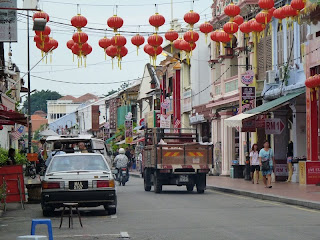

Malaysia, the home of the Proton car, laksa, and in preparation for Chinese New Year, the McDonalds Chicken Prosperity burger!
The bus from Singapore to Melaka takes about four and a half hours and getting through the border was a dream compared to borders in Central America. I stopped at Sentral for a quick bite then headed out to find somewhere to stay. Turns out Melaka gets busy on weekends so it took a little while and then I found a nice, comfy shithole to bunkdown in for the night.
Melaka is proud to now have UNESCO heritage listing and it is a gorgeous little town that has been colonialised by the Dutch, Portuguese and English. And probably anyone else who came along.
Most of the tourist activity takes place in Jonker Walk in the Chinatown. The two nicest things about being in South East Asia (compared to Central America) is the abundance of really good cheap food and cheap massages.
I spent most of my time wandering around, shopping, eating, stopping for a coffee while reading the newspaper - you know, all the leisurely things one does in a place like this.
On Saturday night I headed out to a restaurant called Capitol Satay. Now this is a great idea. Kind of like Korean bbq but in the middle of the table is a boiling pot of satay. So you go and pick up the satay sticks of all kinds of all animals and sea creatures, and some veges, and you dunk it in the pot to cook. The place has a huge reputation as can be evidenced by the queues outside from the minute it opens.
I rounded that out with a walk down Jonker walk and a bit of people watching over a beer in a nice bar there. On the walk back I happened across a bit of a street performance. Sadly I didn't have my camera with me but this was fantastic. The guy was Ho Eng Hui, a Malaysian and Guinness World Record Holder for piercing the most number of coconuts with his index finger in under one minute. Google him - he's amazing. The show included some comedy, audience participation, sales of his own personal herbal remedy, intermixed with soundtracks from Superman, William Tell Overture and I think Rocky as well.
With too much time on my hands in Sydney I thought it was a good idea to get away for a little while before getting ready for India. Not many frequent flyer flights available in January, so a booked a return to Singapore and thought I'd figure it out from there.
I should've known that getting the A380 to Singapore would be fraught with problems, but lucky for me, they served me well.
I first flew to Melbourne and ordered a glass of red before waiting to board. Then they announced a rolling delay. Turns out it's a tad inconvenient to have a catering truck crash into an aircraft. This involved engineers determining the damage, a conference to put in place a contingency plan to change aircraft, and a conference call with Airbus in Toulouse to determine if the aircraft was flightworthy - which it was. But that took four hours to figure out.
Meanwhile, we all got a $30 voucher to spend at the shops in the airport. Catch was it all had to be spent in one place. No guesses where the huge queue was. So with a smattering of snackfoods left, I ordered a spinach and fetta filo roll, three glasses of red (they were quite small) and a bottle of water. Really not a bad way to round out four hours waiting for the plane while reading Bukowski.
We finally arrived in Singapore at 1.30am local time, too late for me to check into my hostel which closed at midnight. So I found a Qantas person to see if they could help. Yes she could is the answer. The kind lady organised a room in a five star hotel and said the concierge would pay the taxi driver. Admittedly by the time I got to my room it was 2.30am and I was pretty shagged. But when I woke up they gave me a full breakfast and, on checking out, another SGD25 to get to the airport. But I wasn't going to the airport so that paid for my bus fare up to Melaka in Malaysia.
Thanks Qantas - the only way to fly!!
Today I begin the long journey back to Australia. Starting with an 18 hour bus ride tonight up to San Jose. On Wednesday I leave Central America and on Friday I arrive back home in Sydney.
Eight months, eight countries, hundreds of chicken buses, dozens of boats, motorbikes, horses, quad bikes, self built cars, mini-vans, taxis, tuk-tuks, utes and a couple of planes. I've read close to 50 books, watched dozens of movies, met hundreds of people. I would hate to think how much beer and rum I've consumed but I have done dozens of yoga classes in several different towns to hopefully counteract some of that. I've eaten more beans and rice and fried chicken than I care to think about.
Central America is beautiful and fascinating. Each country is so different from each other but I think you need to spend time here to really see that. Even the differences between Pacific and Caribbean is huge. Most people wonder how I could possibly spend eight months just in Central America but I can't see how I would have done it any other way.
This blog will take a well deserved break over the Australian summer but I'll be back online in March to report on my new adventures - volunteering in India...


Today I headed out again to that engineering marvel, the Panama Canal. The Miraflores Locks to be precise - an obligatory stop for any tourist in Panama City. It is pretty cool to see the boats being raised up through the locks and passing through. No much else to say so I'll give you some statistics on the canal.
The Panama Canal is 77 kilometres long between the Atlantic and Pacific Oceans. This waterway was cut through one of the narrowest saddles of the isthmus that joins North and South America.
The Canal uses a system of locks -compartments with entrance and exit gates. The locks function as water lifts: they raise ships from sea level (the Pacific or the Atlantic) to the level of Gatun Lake (26 meters above sea level); ships then sail the channel through the Continental Divide.The water used to raise and lower vessels in each set of locks comes from Gatun Lake by gravity; it comes into the locks through a system of main culverts that extend under the lock chambers from the sidewalls and the center wall. The narrowest portion of the Canal is Culebra Cut, which extends from the north end of Pedro Miguel Locks to the south edge of Gatun Lake at Gamboa. This segment, approximately 13.7 kilometers long, is carved through the rock and shale of the Continental Divide.
Ships from all parts of the world transit daily through the Panama Canal. Over 14,000 vessels use the Canal every year - commercial transportation activities through the Canal represent approximately 5% of the world trade.
The Canal was built by Americans (after a failed attempt by the French) and was opened in 1914. The Americans controlled and operated the Canal until it was handed back to Panama on December 31, 1999.
The project to widen the Canal and build two new sets of locks has been underway since 2007 and they hope to complete it in 2014.The reason the French pulled out of the project was the deaths of over 21,000 workers from yellow-fever, malaria and landslides. A further 5,600 workers died during the American construction phase.
Most of the workers came from Jamaica, Barbados and other neighbouring countries and islands. Many settled in Panama once the Canal was completed.


On Tuesday morning I set off for a few days sailing in San Blas or Kuna Yala. This is a part of Panama on the Caribbean side that belongs to the indigenous tribe, the Kunas. It is an autonomous area that is governed by the Kunas under an agreement they have with the Panamanian government.
There are about 365 islands in the area, of which only about 30 are inhabited. Many of the others are used to grow coconuts and they are owned by different Kuna families.
The Kuna are an interesting lot. They have lived their lives quite peacefully there for generations, with the main trade being coconuts, fish and molas (the local handicraft). Apparently they only started dealing with money in the mid-nineties, prior to that trading using barter. Given the islands are pretty much at sea level, there is a program to relocate all of the island dwellers to the mainland in the next five years. These beautiful islands may not exist as they are for much longer if we keep killing our planet.
Many of the children are now growing up wanting a more modern life in the city and to get away from the simple island life. This is a big problem for the Kuna so now the chiefs are creating new rules on a regular basis to stem the flow of people. They need now a letter of permission from the chief to leave the area and this is not always granted.
To get to San Blas, there is a new road with a bridge that has only been completed in the past two months. Now it is really the beginning of the end of quiet, idyllic San Blas. With the bridge finished, they can start moving in the heavy equipment to build a huge marina and hotel complex and I'll bet it won't end there. This type of enterprise will help keep the young Kuna here but it won't be life as they know it.
On the boat we sailed around, visited a few of the islands and did some snorkelling. There was an eclectic group on the boat - a mixture of poms, Canadians, Guatemalans, an American captain and the token Aussie. The Guatemalans were a mother and her two children and I later learned that the mother is the daughter of a former Guatemalan president who now lives in exile in Panama. The kids, I've also learned, are convinced that I'm a writer since I spent so much time on the boat reading.
From Tuesday to Friday this week there were a series of national holidays so the islands got pretty crowded with rich city Panamanians coming out for a night or two of camping. I had planned to stay on an island for a couple of nights after the boat but changed my mind when I realised it might not be the relaxing time I had hoped. Luckily Captain Tony let me stay on the boat another night to get a bit more time there.


Yesterday was a great day. I had signed up for some tour of the Panama Canal, not knowing exactly what it involved but it was a good opportunity to see it. We were collected at the hostel at 8am after very little sleep and driven to a point on the canal where there is a lake - Lago Gatun.
There we were met by Carl, an American who lives in the only houseboat on the lake and he runs tours there. This is the part of the canal where it is wild jungle and it is absolutely gorgeous, except for the ugly parts where they are working on the canal expansion. But the jungle reclaims those areas in a matter of a year or two after they've finished, digging, dredging and blowing things up. We passed some absolutely huge ships going through the canal, making us feel tiny in our little boat.
We saw four different types of monkeys, two types of them came onto the boat and we fed them peanuts and bananas. At Carl's houseboat (which is also a guesthouse) we had lunch and hung out with his menagerie of animals which included a caiman, toucan, three iguanas, parrott, monkey, snake and a rabbit. The rabbit was meant to be food for the snake but the snake was freaked out by it so now it is a pet.
After lunch we kayaked down a narrow canal and swam in a small waterfall and pool. When we got back to Carl's we all lazed around in the water on our swimming noodles drinking beer. There are crocodiles and caimans making this water home but we weren't too concerned. Carl reckoned we should check out some of his videos on youtube so we can see exactly what we were swimming in. I'll have to do that...


