The most important thing when moving to a new place is developing a social network. The great thing about the volunteer community is that in many places this is instantly created and the volunteers who've been here a while are all eager to show the newbies the ropes which is very necessary in a place like Bhubaneswar.
For a start, there's not really any maps - nothing reliable anyway I'm told. It is a big sprawling town and after getting around for a few days I am still as confused about where I am as when I first arrived. Forget addresses, street signs and landmarks - you really need to know where you're going or at least have someone take you the first couple of times until you get the hang of it.
I was lucky after meeting Ashley in Berhampur, she connected me to the volunteers in Bhubaneswar and it turned out to be a relatively productive week with Paul taking me out to a dance festival and a ride around town, Evans helping me try to register at the foreign office, clothes shopping and various other practical necessities.
This was topped off by a weekend at Gopalpur-on-sea with group of volunteers and expats. I wasn't expecting it to be so soon that I'd be swimming and relaxing at the beach - albeit an Indian seaside resort and swimming with clothes on. I'll take any opportunity I can while I'm here to cool off. Gopalpur is a really nice and quiet seaside town and one I'm sure I'll be back to and write more about later.
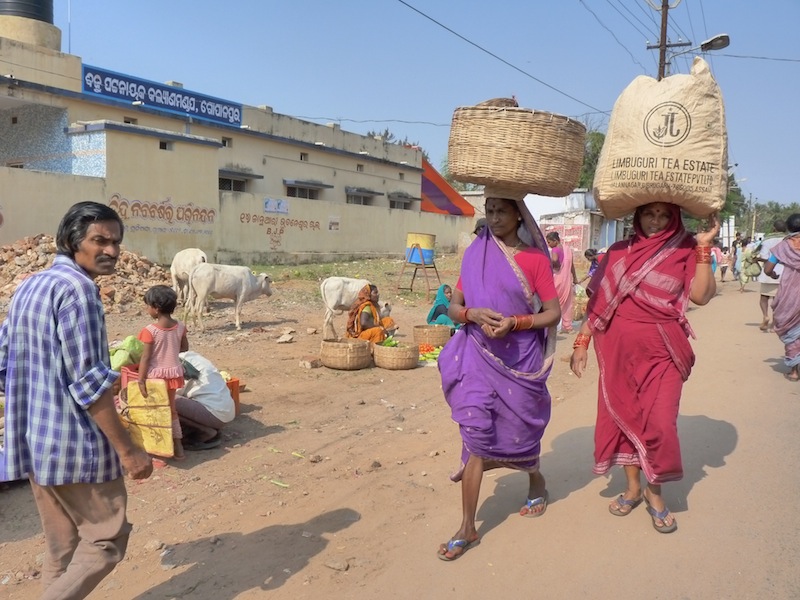
Arriving in Bhubaneswar I was struck first by the warm air and dust. Sujata, my new colleague, was there to meet me at the station and the auto-rickshaw managed to squeeze three of us and all my luggage to take me to my temporary home at the CYSD which is an NGO with training and accommodation facilities.
Sujata told me that I will be collected at 7am the following morning to go on a field trip. She told me more than that but that is all I could comprehend at that point in time. Kelis, the guy here who has been asked to take care of me said breakfast is at 7.30am and offered to bring me tea at 6.45 which sounded good. So I am down at reception at 7am but don't get collected until 8.15am - in the meantime I had more tea (fantastic) and breakfast (curry). Then I get collected in a big 4WD with a group of people, then we get more people and then we're off. So there's 10 of us in this 4WD and another 4 in another car in front. At 11am we stop for what I thought was early lunch and had curry and this gorgeous milk cake. At around 1pm we stop for lunch. I'm already full - at this point I've had two curry meals but I can't offend so I order a vegetarian thali and each some of it. I am absolutely amazed at the appetites these people have, they can put away serious amounts of food. I have also started to eat with my hand. It is difficult getting used to using my right hand and really quite a weird experience but I have to do it. One of the delegates complimented me on my ability which was nice since it was my first day of trying to eat like that.
Then after lunch we finally arrive at the place in Behampur where we are meant to be going to visit an RTI clinic. There is another vol there so we had a good chat but she is leaving in two weeks. She has put me in touch with another vol here in Bhub which is great. Anyway we sat around on the floor for a few hours and they talked about the RTI Coalition (where I'm working) - mostly in Hindi or Oriya and little bits in English. I had a tiny bit of an idea what was going on. Then afterwards we went to a nearby slum colony where we sat on plastic sheeting in the middle of the road for the next meeting where some of the locals came to talk to us about their experiences with RTI. About 20 or so cows walked through and there was one dog who took offence to the cows so the people were giving the dog a hard time - no one is mean to cows! Then we get back in the car and go to Gopalpur - a seaside town. By now it is 7pm and we walk onto the beach and get our feet wet and someone brings us coffee. Then we get back in the car to go home. Nishi tells me we'll be home in three hours but in about two hours we stopped for dinner - yes, more curry but at this point I was able to eat something, then another three hours more after that to get home. I arrived here about 12.15am. So that was day one.
The temperature here seems to rival Sydney that week of the heatwave and it is going to get much hotter in April and May.
On Tuesday afternoon Nishi picked me up on his bike to take me to the office where I will be working. Gobinda is the guy who runs YDF which is the NGO the RTI Secretariat will now be based, it rotates between the member NGOs each year so it has just moved to YDF which turns out to be good as it is nearer the apartment where I'll be living. Gobinda runs me through things and loads up my laptop with heaps of docs on RTI and the Coalition, then the Jharkand delegation from yesterday arrives so I sit with them for a while for another session then I'm called to a meeting with another bunch of people to talk about mobilising youth against corruption where there was also a journalist. At this meeting they tried to talk in English but reverted to Oriya a bit so it was hard to get the gist.
The other thing I should tell you about is Kelis, my guy here at CYSD. See I am quite a novelty here and am usually just stared at but sometimes groups of women say hello and giggle together. I think Kelis is proud to be in charge of me and is doing everything he can to make me comfortable. Yesterday he came to my room to tell me about breakfast - he was concerned I hadn't arrived home the previous night but I told him we got back late. Whenever he comes to the door, he walks into the room and curiously surveys my things - all my undies were hanging on the line above my bed yesterday but what can you do. On the first night I had had a rum when I arrived and had the bottle sitting on the table so he asked me about that - it has been hidden ever since. I have a balcony but sneak around to smoke on it. This morning he came at 7.15am and woke me up to tell me that the bathrooms were busy and if I wanted to use them I might go downstairs and find another one. He then offered me tea (which is a huge privilege - no one else gets that service) so since I was now awake I thought that would be nice. So about half an hour later he brought it to my room (I was still in my PJs) and decided he would come in and sit on my bed and talk to me while I drank it. He told me breakfast would be at 9am. Then at 8.30am he came again to tell me breakfast was ready so I got up and had a shower to get ready. Then at 12pm he came again with tea (again he sat on my bed while I drank it) and I said I needed to find Reeta to get on the internet so he waited while I got ready. Literally stood in my tiny room and watched everything I did until I walked out with him. So I feel very much public property here - there is no harm meant, everyone is just very curious but it is going to take a little getting used to.
I think after here then three weeks in Delhi I'll be very happy to move into my small apartment.
It was great to finally arrive in Delhi after a long flight via Dubai and a fair bit of to-ing and fro-ing about when I would actually leave. See my visa came through a few days before I left but some of the other volunteers had delays which meant the In Country Orientation (ICO) was now to be delayed by two weeks. Sick of sitting around Sydney I managed to arrange to go anyway. At the very least, a few weeks in Delhi to shop and sightsee would be a great way to kill some time. Alas, my hopes of extending my ridiculously long holiday were thwarted by the reality that I am here in India to work so after a day of acclimatisation in Delhi, I was on the train for the journey across the sub-continent to Bhubaneswar, Orissa, my new home.
I was pleasantly surprised by the train journey. I mean it is India and the distances are huge but for a 26 hour train trip it was very comfortable - bed, linen, air conditioning, constant delivery of food and tea and water, a powerpoint even! Sharing a compartment with three middle-aged Indian men who snore extremely loudly was only manageable with ear plugs and headphones. One needs a large selection of entertainment material on these journeys - books, music and music.
So, Burma. The land time, and the world, forgot. The land without credit cards and ATMs, very few mobile phones or ipods, very little and at best, slow, access to the internet. Where monks mingle with the mortals and women have white-painted faces. Where roads are being built by teams of women laying different sized rocks with a string line while the men boil drums of tar for the final layer. Where walking down the street involves dodging holes, gaps and red spittle. Why come here?
A visit to Burma is to see what a lot of South East Asia, I imagine, used to be like many years ago. Culture and tradition are observed and it is a very conservative society. The people are genuine, friendly, curious, playful, happy to have us in their midst.
As my Czech-Canadian friend told me on the first night, travelling here is hard. The roads are terrible but that is the only way to get around without putting money in the government’s pockets – they control the airlines, railways and boats. I wasn’t as careful with the food as I could have been. The air quality in some places at this time of year is dreadful. Getting food in some places is really difficult. Getting anything for that matter. You need to find people who can help you out and stay in guesthouses that offer to help as well. The general standard of accommodation is very basic. There is virtually no connection to the outside world unless you seek it out.
But the rewards are huge. It takes time to get around and I hope to come back and use up the whole 28 days of my visa next time, as most travellers seem to do. Things are simpler here, fewer distractions. But life is also hard for many.
It is so nice walking down the street in the evening, seeing groups of men playing kick with a small rattan ball in my street. There were also groups of boys kicking a soccer ball around, and two other groups of men playing some kind of board games, one with a rudimentary game sketched out on some scrap paper. That was all in a stretch of 100 metres. There is a strong sense of community – something I fear we have all but abandoned in the west, except in times of disaster and sporting events.
Unlike my experience in Cuba several years ago, the government is never spoken about and there is a real fear for anyone to discuss it so most conversations with locals are polite and about the weather and family and all that small talk. Many parts of the country are closed to foreigners, even the new capital. All the embassies are still here in Rangoon.
Obviously not a poster-child for human rights or democratic process, the Myanmar government have a strong hold on how Burma is seen in the eyes of a tourist. Every guesthouse must log our passport and visa number so the government has a record of our every move. It would be great to visit some of the other parts and get an insight into the struggles of the people and some of the minority groups and see how society functions at a deeper level, but you can’t even scratch the surface with such strong controls and a short amount of time.
But it is still worth a visit, the Burmese people really want you to come. I'll be back, that's for sure!
Scary to think that in 28 days I will be beginning a new adventure in Delhi…
I was very happy to arrive back at my friendly guesthouse in Rangoon, and yes, they had a room for me and yes, unlike other guesthouses in Burma, I could have breakfast today as well as tomorrow. So happy – this is after all the “best buffet breakfast in the world”. And it really is pretty good, although part of the deal is having the owner tell you the entire time you’re eating how good the food is, how breakfast is the most important meal of the day, how they have over five hundred recipes and they are always changing the menu, etc, etc.
I was glad to be back in Rangoon although I’m disappointed I didn’t get to spend much time at Inle.
Familiarity is always nice so I pottered around town, visited the markets to buy some final gifts, had chai on the street, and rested while I caught up on this journal.
In the evening I wandered through some food markets where I witnessed catfish jumping out of a steel bowl and slithering down the street. I wasn’t quick enough with my camera so I waited a while but I think they were exhausted. In the middle of the road there are children selling things as well. There was one girl in particular, probably about ten, selling badly undersized fish on two big steel trays. When a big truck came down the street, everyone squeezed to the sides, the fish stayed there and the truck went straight over the top of them -wheels either side. Then she just went back to where she was, hoping for a sale.
Chinatown was hopping tonight with Chinese New Year festivities getting underway and everyone was out with all sorts of noisemakers being sold. I was too tired to wait for the dragon dance rehearsal but it was nice to see some of the action.
It was a ten hour ride to Lake Inle (including the obligatory dinner and inexplicable 2am tea stops) and at 3.30am, me and two German tourists got out at Shwenyaung where we were met by a pickup which took us on the half hour drive to Nyaungshwe. It was absolutely freezing but about the same temperature as the bus. Luckily for me Tun Aung had phoned my guest house ahead (yes, he really was my saviour!) and while they were full, they set up a small room I could use to rest until my room was ready in the morning.
I figured I had to see the lake today since I’d lost time in Mandalay so headed down to the river just after 8.30am, found a boat driver, found another tourist to split the cost of the boat with, and we were off.
In the southern part of Shan state, the lake is a large working lake with lots of communities on the banks and some in the marshy parts of the lake itself. Ondres, my Czech companion, suggested one of the villages could have been what Venice looked like many centuries ago. There are dozens of men and boys fishing on the lake and a huge amount of produce is grown on the bans and in the marsh areas.
We were both a bit pagoda and monastry-ed out so were happy to cruise around the lake and visit some of the villages.
It actually turned out to be like one of those shopping tours. It was hilarious but we both really enjoyed it and the weather was just perfect. First we visited a local market. The lake has a five day market roster so only certain villages have markets on certain days, and they rotate. So we went to the main one today which was great. We got a late start compared to most so were lucky it was still going on. A lot of the stuff at the market was for locals but there was also a little bit of the tourist stuff and I ended up buying a few things I didn’t want or need, just to get some of the ladies off my back. They were good fun though.
Next we visited a silk/lotus/cotton weaving place – and of course showroom. They did produce some beautiful things. I didn’t even know you could weave from lotus. It is seven times more expensive than silk because of its short harvesting time and the labour required to extract the thread. It is quite a rough thread too but I guess when you’ve seen the process you can appreciate it.
Next was a cigarette making place where we were given tea, rice crackers, and cigarettes while the young girls rolled cigarettes and cigars in front of us. One of them was mixed with aniseed and was rather like smoking Pastis. The other was tobacco soaked in the juice of banana, pineapple, papaya, tamarind, and a few other things. That was a little strange too.
Lunch was at a pleasant restaurant over the water although my noodle soup turned out to be a spicy Shan variety rather than the bland kind I was hoping for.
After lunch we visited a pagoda, a silversmith and jewellery maker, and a paper and parasol maker. By this time it was getting on 4.30pm so we skipped the monastery so we could get back before the sun started setting and the cool evening air settled in.
Ondres had been to Burma seven years before and has come back to visit many of the people he met on his last trip. We had dinner at the restaurant of his friend who was really sweet and wouldn’t accept any money. By this time I was feeling really bad about such generosity so I left money on the table but he came and gave it back to me. What can you do? Next time I need to come prepared with gifts for all of these kind and generous people – money is just the wrong thing for these occasions.
On the market roster, today was Nyuangshwe’s turn. The market was really bustling with pretty much anything imaginable for sale (but I didn’t see any animals or meat).
The monks were all out in full force as well, collecting their money in the rice bowls. One thing I haven’t mentioned yet is the way the monks are part of everyday life here in Burma. Everywhere you go there are monks of all ages, from really small children to the elderly, men and women. However in the morning and particularly at markets, they are collecting donations. Generally they are very pleasant and offer a shy smile if you catch their eye. Although some of the young boys can be a little pushy, not very monk-like I wouldn’t have thought. It is nice when you give them some money and they stand around you and do their chant (although I couldn’t help but compare it to the greeting you get when you enter one of those sushi train restaurants at home).
After the market I thought I’d try a traditional Burmese massage given I’d had a bit of a rough trot. It was a bit like Thai massage but not.You are massaged with your clothes on, then walked on, then at the very end, she rubs oil on your skin, under your clothes. It was quite nice and my masseuse was really sweet. She is the eight generation in her family to practice massage and it is a technique they’ve handed down through the generations. She is now teaching her eleven year old niece, who apparently is quite talented.
After lunch I got a pickup back to Shwenyaung for (thankfully) my final night bus back to Rangoon.
There’s about fourteen bus companies that ply this route so all the backpackers there were waiting for whichever company their guesthouse booked them a ticket on. Mine turned out to be not so great. After being 45 minutes late (and I was an hour early) the bus finally arrives with only two rows of seats available. The entire rest of the bus was packed to the ceiling with white bags of cargo.
I’m still getting over it so let’s just say it was a rather uncomfortable 18 hour ride on a mechanically unsound bus.
Today was the big sightseeing day to Amarapura, Sagaing, Shwenandaw Kyaung,and the Mahamuni Paya, one of the top three in Burma (the other two being the Shwedagon in Rangoon, and Golden Rock).
Shwenandaw Kyaun is an old teak monastery that used to be located within the grounds of the Mandalay Palace but was dismantled and moved in the late 19th century. That turned out to be fortuitous because it escaped the WWII bombings. It is now used as a meditation centre and not a monastery.
The Mahamuni Paya, after Shwedagon and Bagan, didn’t thrill me. But there was a really big buddha that people (read: men only) donate gold leaf to so this thing is getting bigger everyday, and rather strangely shaped. You can see the men going up to apply the gold leaf to make merit, while the women are down the back praying and offering leaves and flowers.
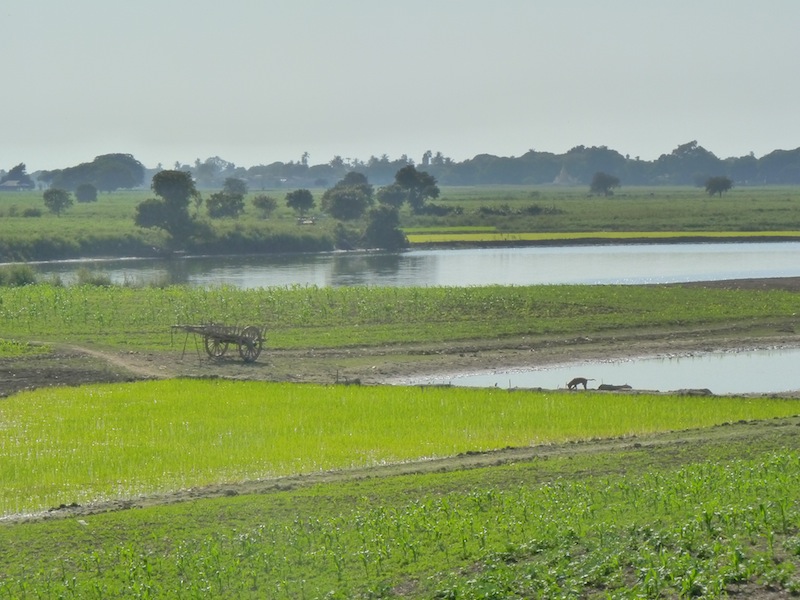
The drive out of town was gorgeous with beautiful fertile plains and small farming communities producing all kinds of fruits and vegetables using old fashioned and traditional farming methods. You don’t see any machines around here, bulls drag carts loaded up with whatever needs to be loaded up. People are in the fields with hoes and traditional tools.
Sagaing has over 600 golden stupas on a series of hillsides on the banks of the Irrawaddy. It is a stunning and peaceful place where many Buddhists come to spend time meditating with the monks. Sagaing is a big monk centre with a population of over 6,000.
Just down the bottom of the hill and across the river is a small port where they load up the beautiful old teak logs for transportation to Singapore. The paradox of peace and destruction wasn’t lost on me. Considering teak is such a fast growing hardwood, and Burma has around 70 per centof the world’s teak wood resources, you might think they’d consider sustainable forestry. But no.
Finally we headed to Amarapura which is a beautiful old town, and a former royal capital. The streets were full of traffic and people. It turns out that a very famous monk died the day before and this was the ceremony for his funeral. The road was so jam-packed with thousands of people, with singing and a big elephant creature dancing up the street, that we turned back and found another road to our destination – U Bein’s Bridge. This is a 200 year old, 1.2 kilometre teak footbridge that crosses the Taungthaman Lake. It is absolutely stunning – and very rickety to walk along. There were loads of people down on the shores, and men fishing with old bamboo poles, up to their waist in the lake.
Tun Aung suggested we wait nearly three hours there for sunset but that was a bit too much for me feeling as I was. So he agreed to pick me up earlier tomorrow before my bus to Inle and take me there at sunset. I forgot to mention that earlier in the day I told him I needed a bus ticket to Inle so he pulled over at one of those places where there’s a phone on a table under a tree and you pay the lady a couple of hundred kyet to make a call, and he booked me on a bus for tomorrow night.
Anyway, leaving the bridge we headed back through Amarapura and ran into the funeral procession again. By this time they had the body down at the river, where he would soon be burned and the ashes taken to one of the pagodas. Seeing so many people out for the ceremony was quite moving.Obviously revered in the community, his funeral was attended by several police and government officials.
So I returned to the hotel, crashed for a couple of hours, then ventured out for my fateful mutton curry at the chapatti stand, after, of course, my beer at the ice-cream shop.
No need to go into specifics but food poisoning is never fun, particularly when your throat feels like you’re swallowing razor blades.
Optimistically I checked out of my room at 1pm to lay on the hard wooden bench (Chinese style) in reception to wait for my saviour to collect me at 4pm to take me to the bridge, then the bus station.
At 1.45pm, I checked back into my room.
Tun Aung arrived at 4pm and, as I had no way to contact him, I couldn’t have let him know before now that I can’t get on that bus tonight. He made a quick call, postponed the bus, got the girls to get me some hot tea, sent me back to my room to rest and went out to get medicine.
About twenty minutes later he arrived with some tablets, rehydration salts and biscuits and ordered me to eat before taking the tablet, then sip the rehydration solution that he made up while also drinking tea. He set everything up in my room and when he was satisfied I should be okay he left.
I had a pretty rough night but convinced myself I was feeling better. At this point I really needed to get out of Mandalay, although spending time indoors was good from a dust perspective.
At 8am Tun Aung phoned to check on me and then I spent pretty much the rest of the day as yesterday, laying around, sleeping and watching movies on my computer, all while listening to the strange sounds of Mandalay out the window.
I popped out in the late morning for some more medication to make sure I would be okay for the bus tonight. Then I checked out at 1pm to spend three hours on the hard wooden bench but the staff generously gave me my room back after 15 minutes, feeling sorry for me laying on the wooden bench.
The bridge at sunset was truly beautiful and after getting out and about (and taking a lot of medication), I was feeling a fair bit better.